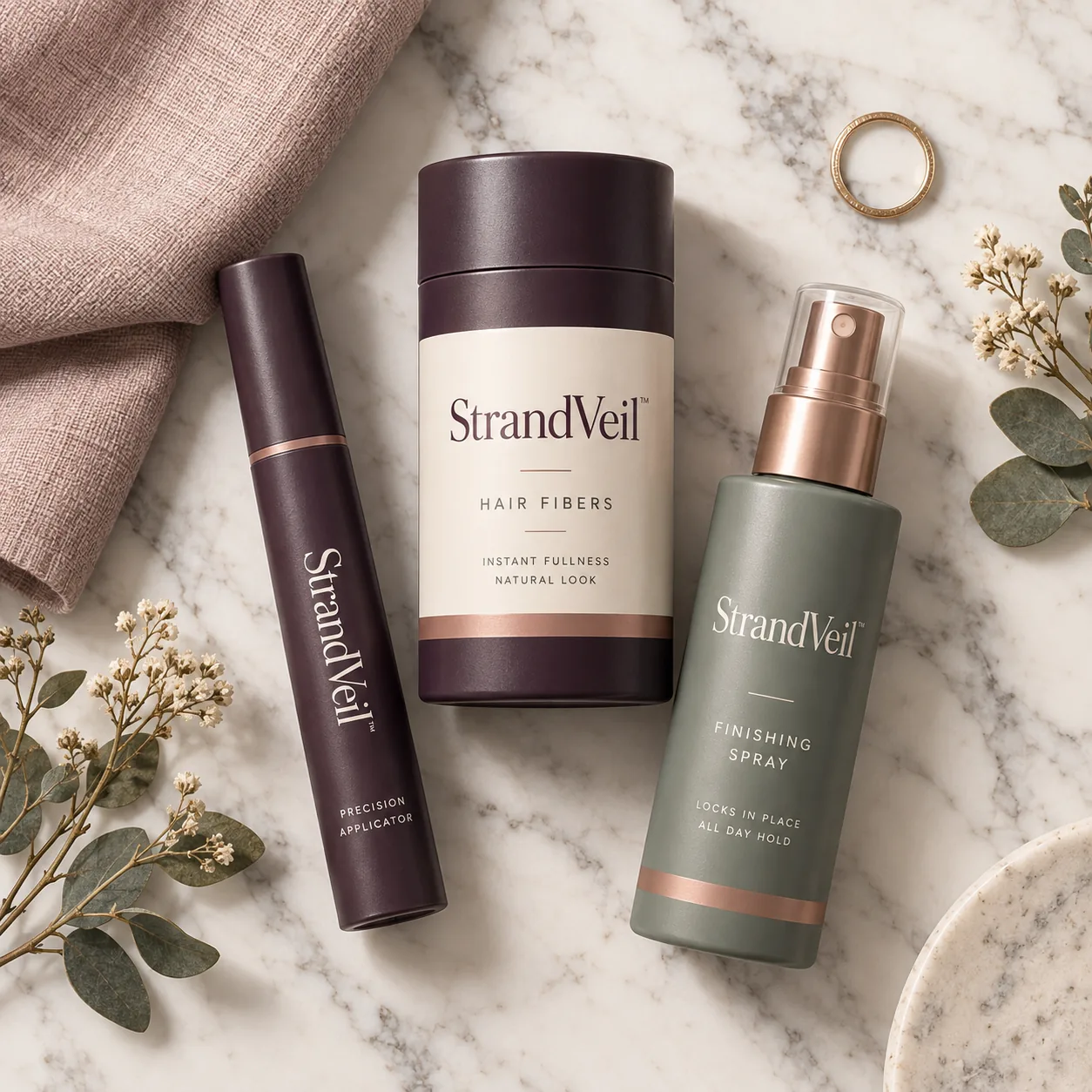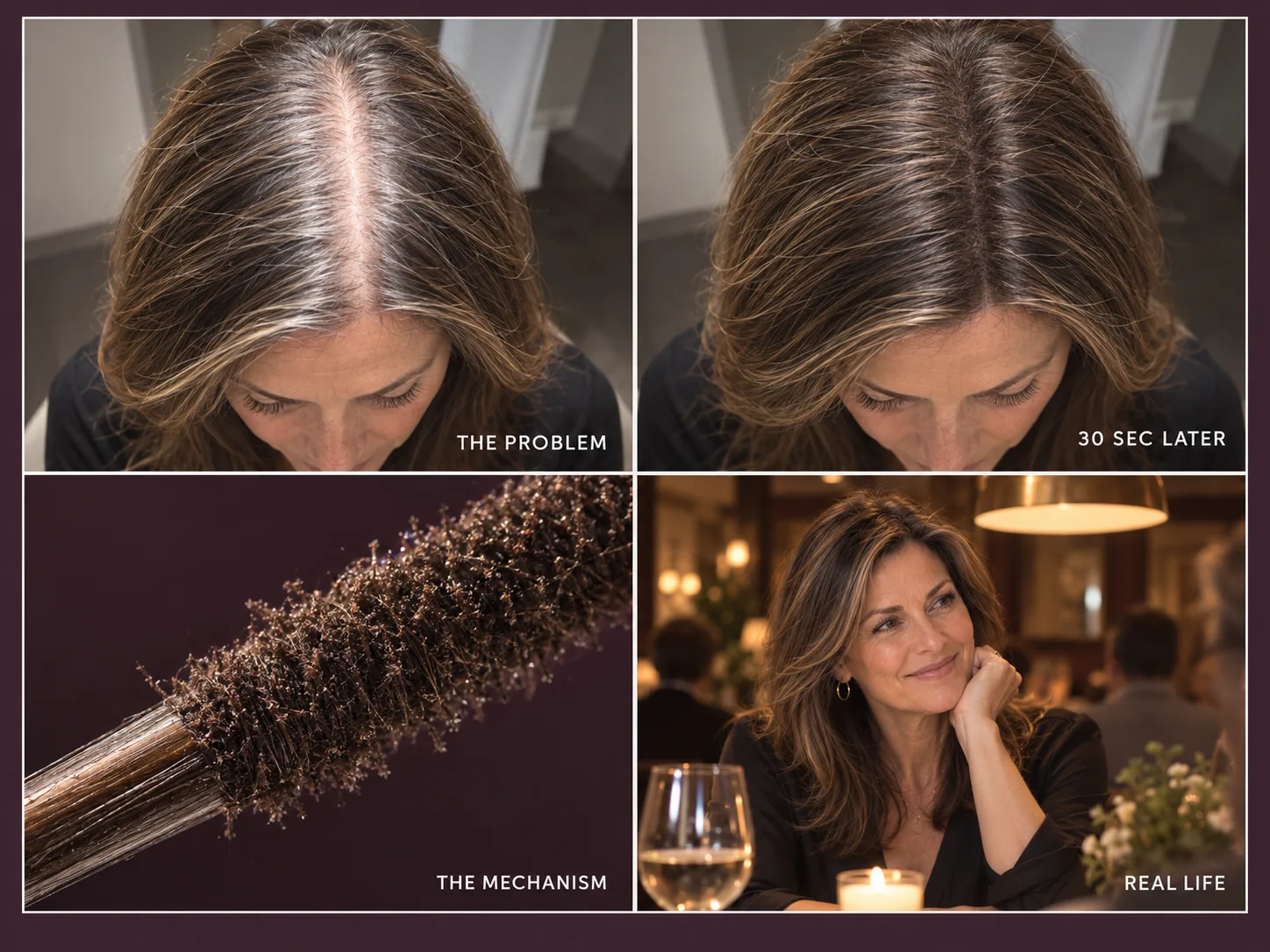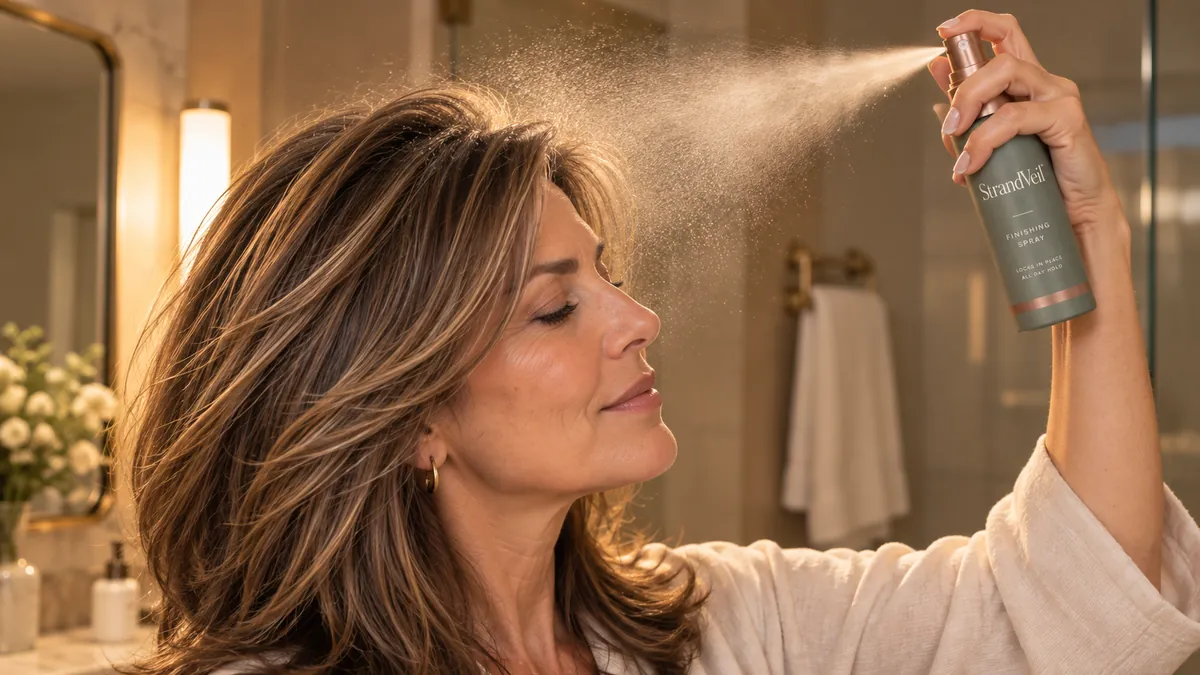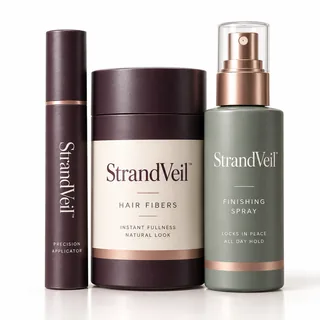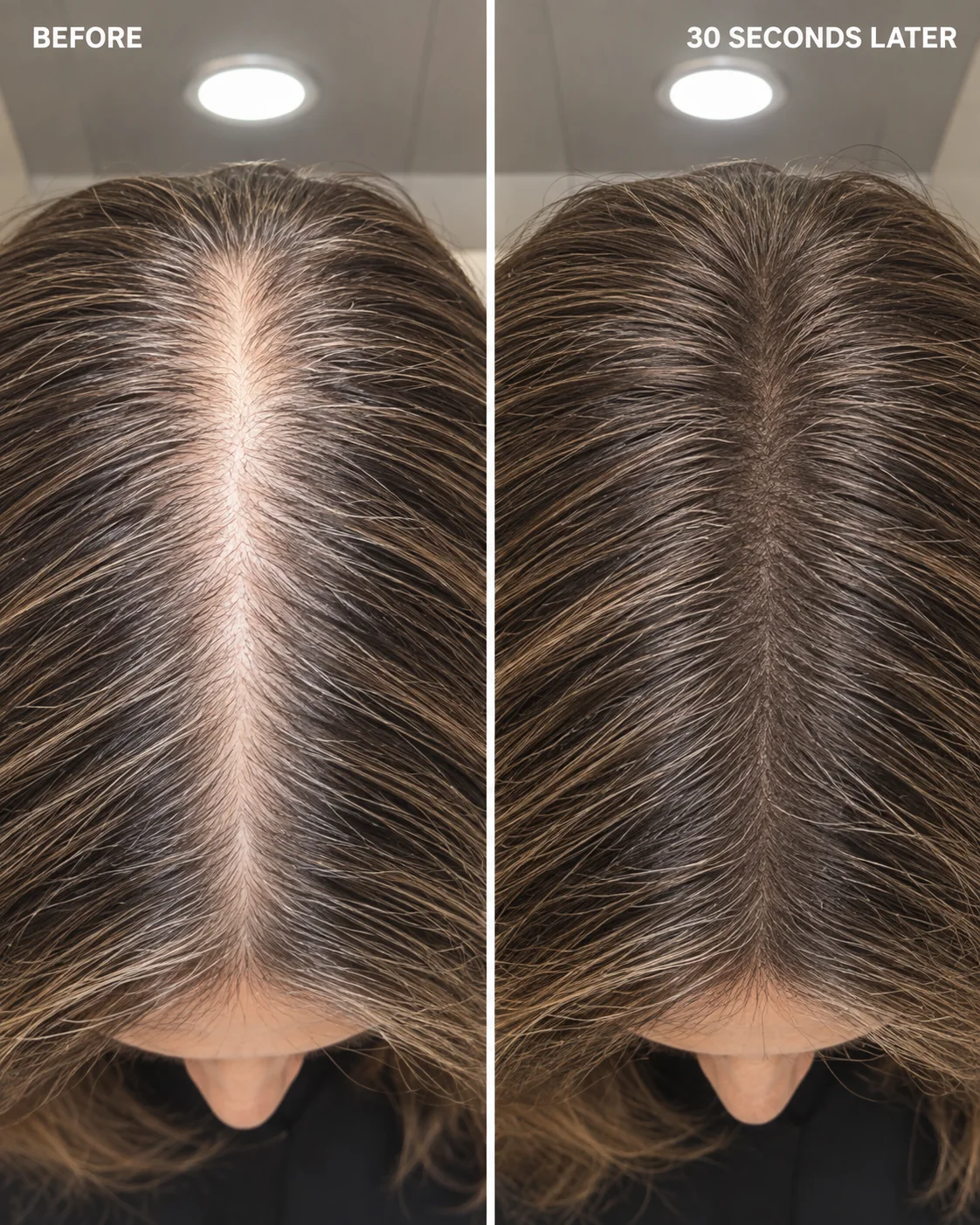




StrandVeil's precision keratin fiber system is designed to reduce the scalp contrast that overhead lighting exposes — using a simple AIM → BUILD → SET routine for widening parts and diffuse thinning.
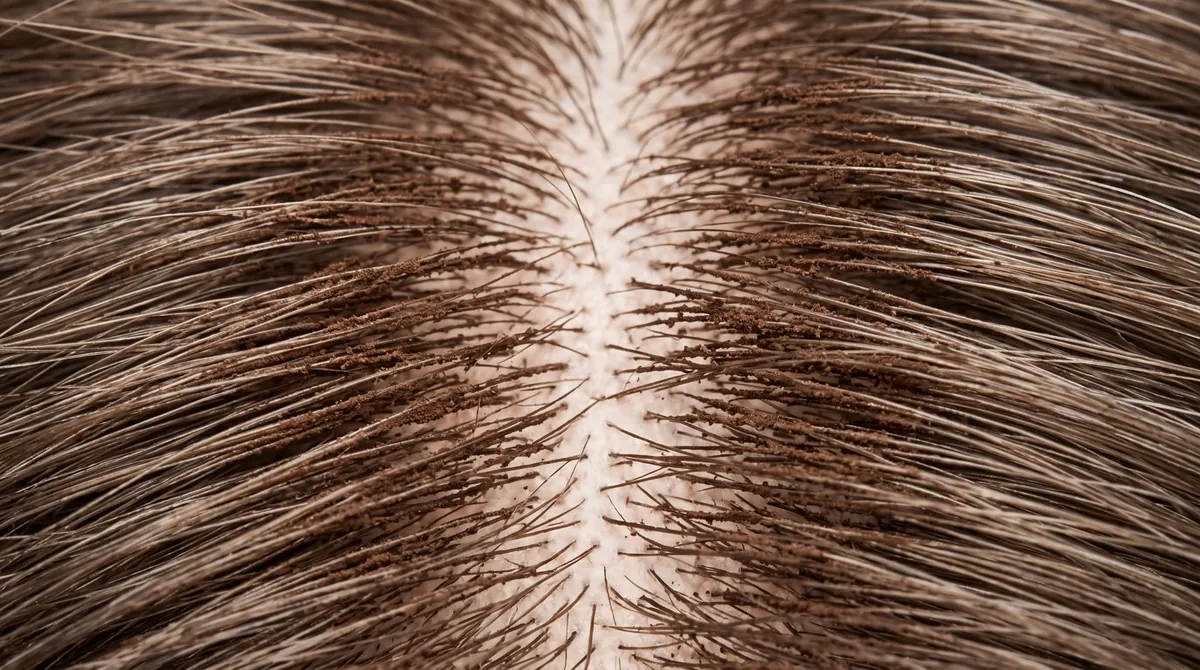
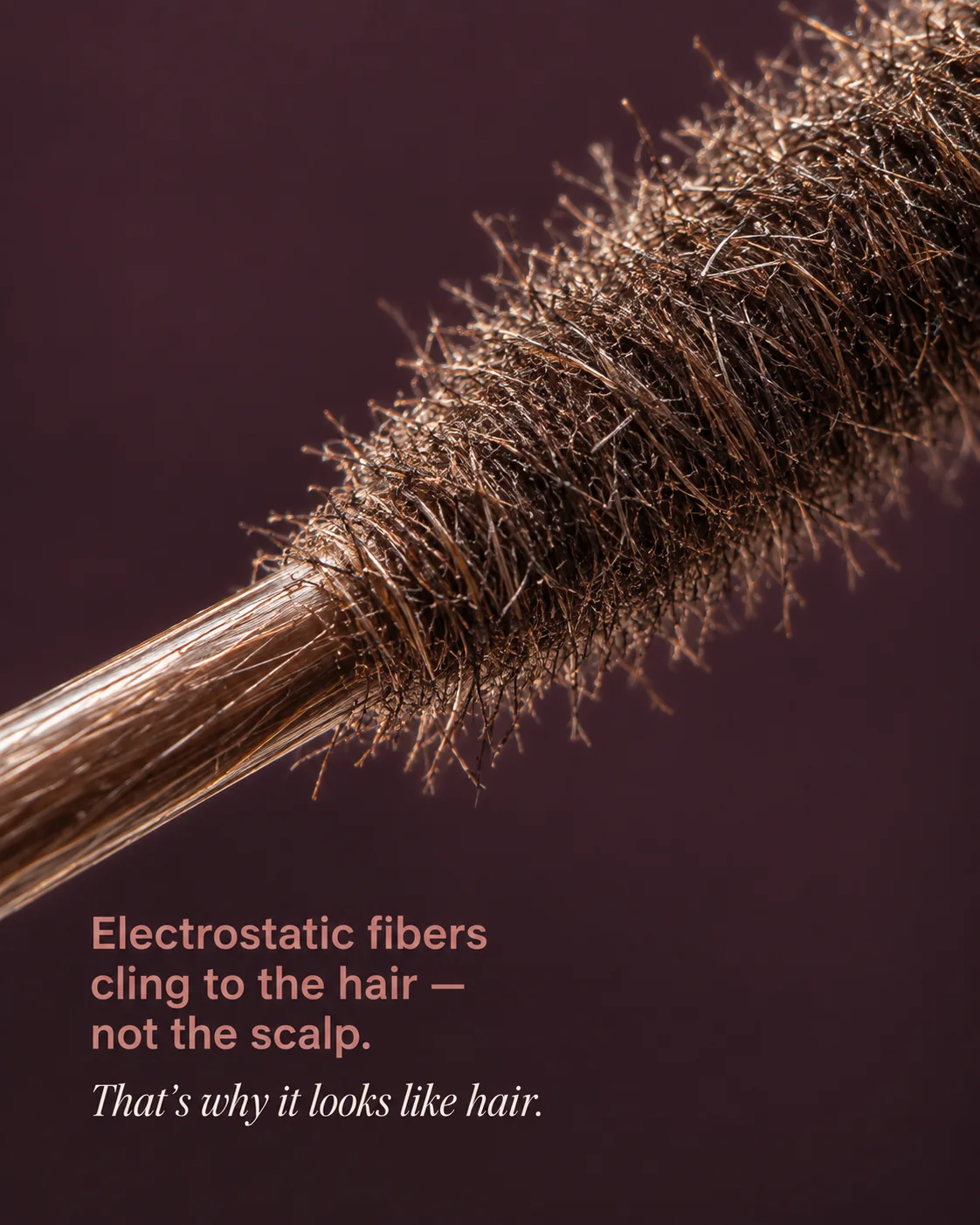
That's the exact problem the system is designed to minimize. Unlike scalp-color products, StrandVeil uses hair-building fibers that cling electrostatically to existing strands. The precision applicator helps target the area instead of broadly dusting it. The goal is more fiber integrated with existing hair and less loose product sitting visibly on skin, so the finish reads as added hair mass rather than a flat layer of pigment.
The SET finishing spray is what makes the coverage practical for a full day. Applied correctly, it secures the fiber coverage through normal daily movement — a commute, an office day, an evening out. Wind. Light contact. Normal wear. The setting step is not optional: it is the difference between coverage that holds under real conditions and coverage that only works in the bathroom. Wash out with regular shampoo at the end of the day. If you plan to exercise intensively, apply after rather than before.
Yes — and this is worth knowing before you order. The fibers cling to existing strands. For diffuse thinning and widening parts — the fine, see-through strands that let scalp show through — the existing hair provides the foundation the fibers need. In areas with no hair at all, the system won't work. If your thinning is diffuse rather than fully bare, StrandVeil is built for exactly that condition.
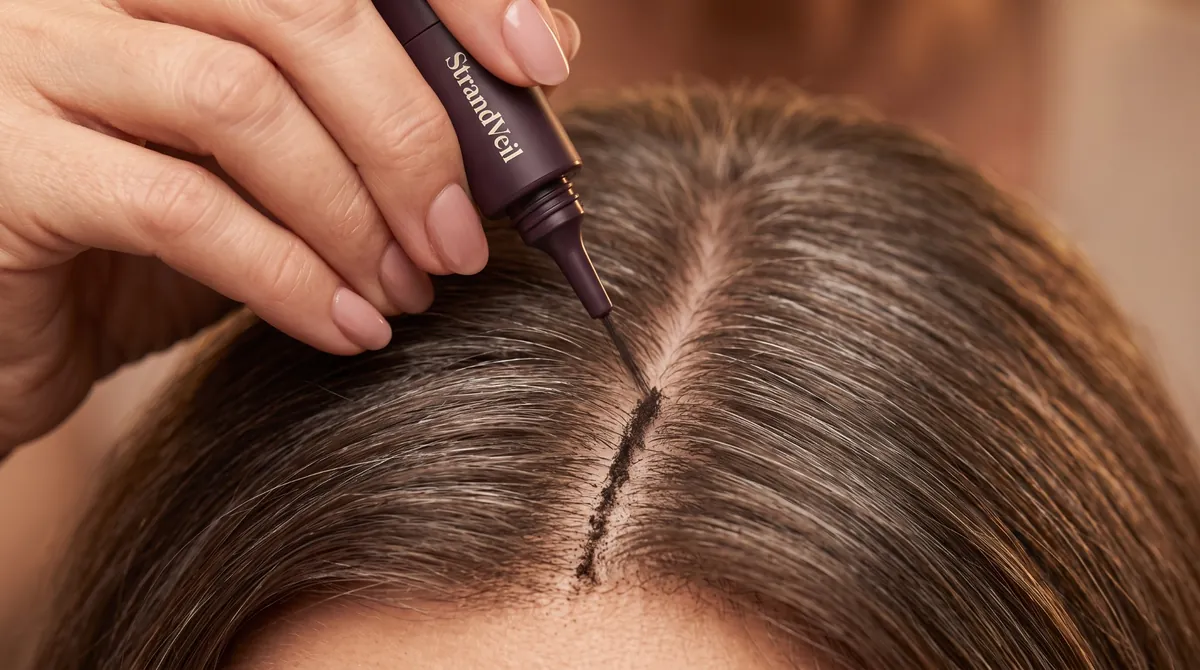
The precision applicator is designed to direct fibers where you want coverage instead of broadly shaking product over the scalp. Start with a light pass, build gradually, and apply before makeup so any stray fibers near the hairline are easy to brush away.
No — and that distinction is central to what StrandVeil is. Male vertex baldness and female diffuse thinning have different coverage patterns and practical needs. StrandVeil's widening-part application, precision applicator, and three-step routine are built around the way women commonly experience diffuse thinning. It is female-first by design.
This is one of the most common questions, and it deserves a direct answer. Hair at this life stage is rarely one uniform color — there's usually gray worked through it, highlights from salon color, or natural variation in how different strands catch light. The concern is that one shade will create an obvious flat block of color that reads as coverage rather than hair.
Two things worth knowing. First, because StrandVeil fibers are distributed across existing strands rather than applied in a flat layer to the scalp, the result reads as overall density at normal social distance — not as a single painted color. The variation in your existing hair provides the tonal range the eye expects. Second, shades can be layered or mixed: a lighter shade feathered in alongside a slightly deeper one produces a more dimensional result for women with complex coloring.
When in doubt, choose the shade closest to the majority of your hair — not your gray. The fibers blend with the full range of your existing strands and tend to read naturally across highlighted and color-treated hair.
Bathroom mirrors, office lighting, photos and getting-ready routines — the use cases StrandVeil was designed around.
Each describes a specific change — not just coverage, but what coverage changed.

For many women with diffuse thinning, part of what changes is hair diameter. Hormonal shifts around perimenopause and menopause can coincide with progressively finer strands. Even when plenty of existing hair remains, finer strands can provide less visual mass and allow more scalp to show through under overhead light.
Finer strands let light through instead of blocking it. When enough strands lose enough diameter, the scalp beneath them becomes visible — particularly under overhead downward-cast lighting, which illuminates the top of your head at a near-vertical angle and maximizes contrast between your hair color and the pale scalp below it.
We call this the scalp-contrast gap: a simple way to describe the visible contrast between your hair and the scalp showing through it. The immediate cosmetic problem is visibility and coverage; the underlying reason your hair is thinning is a separate question.

Human hair carries a slight natural negative charge. StrandVeil's keratin fibers carry the opposite — a slight positive charge. When directed toward existing strands, the charge difference does what opposite charges do: the fiber is drawn to the hair shaft and wraps around it, increasing the strand's apparent circumference. The same principle that makes a balloon cling to a surface after you rub it against fabric. Documented physics, not a marketing claim.
The result: fiber that adheres to hair — not to the scalp skin beneath it. When fibers wrap around existing strands and add to their apparent diameter, overhead light reads additional hair mass rather than exposed scalp. That is why the bathroom light that has been finding the gap stops finding it.
StrandVeil combines electrostatic adhesion with a precision applicator and a setting step — three components working together to close the scalp-contrast gap and hold it through a full day of real conditions.
For a typical widening part or crown area, the routine is designed to take about 30 seconds once you're familiar with application.
Specific mechanism comparison — not "better," but different in the ways that matter under the light that matters most.
| Root Spray / Powder | Loose Shaker Application | StrandVeil Full Kit | |
|---|---|---|---|
| Where fiber lands | Pigment applied to scalp skin | Broad scatter — hair + scalp + counter | Precision-directed toward existing hair shafts |
| Result under overhead light | Tinted scalp skin — can read as painted | Partial — imprecise placement limits result | Hair mass closes the gap from above |
| Durability through the day | Transfers on contact; degrades in humidity | Migrates without a setting step | Finishing spray locks coverage through normal wear |
| Setting step | Varies by product | Often separate or skipped | Included — not optional |
| Built for | General-purpose root coverage | Often built for male vertex baldness | Female diffuse thinning and widening parts |
Apply the system, then run the test you've already been running: stand under the bathroom ceiling light, hold the phone camera at the angle that's been finding the gap. The cosmetic effect is immediate — you can judge the result in the same conditions that have been finding the problem, before you leave the bathroom. Most women do not need to wait to know whether it is working.
With a little practice, you can learn how much fiber gives you the coverage you prefer. Start light, check the result, and add only where needed.
The goal is for the three-step routine to become a simple part of getting ready — temporary cosmetic coverage when you want it, without turning it into a medical routine.
Start lighter than you think you need. You can build layers; you cannot easily remove excess. Begin with one light pass and add more only if you want additional coverage.
Lift the hair on either side of the part before applying. Fibers reach the root area more effectively when the surrounding hair is slightly separated.
Apply before makeup, not after. Occasional fiber landing near the hairline is easier to manage before foundation.
Set every time. The finishing spray is the last step because it helps make the completed coverage more secure for normal daily wear.
Use it where there is existing hair. StrandVeil needs strands to cling to, so it is best suited to widening parts and diffuse thinning rather than completely bare areas.
How long a kit lasts depends on the size of the area you cover and how much fiber you use per application. Start with a light layer and build only where needed. Because usage varies from person to person, we do not promise a fixed number of days per kit.
StrandVeil is a cosmetic coverage system, so you do not have to choose between improving the look of your part today and pursuing a separate long-term plan. If you use a topical medication, follow that product's directions and let it dry or absorb as instructed before applying other hair products. Ask your clinician or pharmacist if you have questions about compatibility with your specific treatment.
Start with less than you think you need and build gradually. A lighter first pass usually gives you more control and makes it easier to keep the finish natural-looking around the part and hairline.
StrandVeil is designed for temporary cosmetic coverage and washes out with regular shampoo. It is not positioned as a treatment for hair loss and is not intended to change follicle biology or hair growth. If you have an active scalp condition, irritation, or a medical concern, check with an appropriate healthcare professional before use.
For the cleanest routine, wash StrandVeil out with regular shampoo before bed and reapply when needed. Contact with pillows or hands can cause some transfer depending on application and wear conditions.
Once you're familiar with the routine, StrandVeil is designed to reduce the look of visible scalp in about 30 seconds with three simple cosmetic steps. You do not have to wait for new growth to improve how your part looks today.
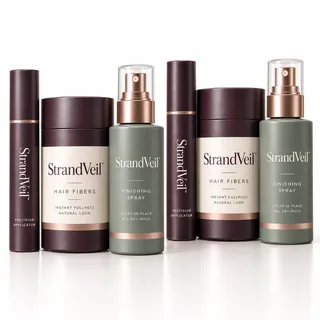
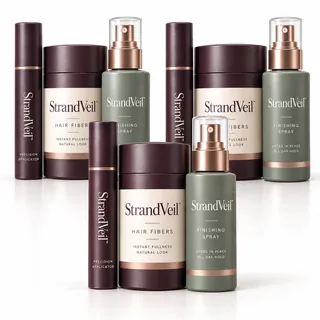
Only $15 more than the 2-kit option — at half the per-kit cost of buying one at a time.
No subscription. No hidden charges. One-time payment.
In one future, the morning stays what it is. The part line stays what it is. The bathroom ceiling keeps finding it, the restaurant pendant keeps catching it. You steer toward the seat with better lighting. You check the camera angle before pressing the button. The group text photo arrives and you open it with the pause — the specific pause before you look — and make a call about what to do with it. You manage it. You are good at managing it. Nobody knows. But part of you is always somewhere else — in the room and also running something in the background that never stops.
In the other future, you give this sixty days. The morning compresses to thirty seconds. The office fluorescent finds nothing. You sit where the seat is, not where the light is. The photograph arrives in the group text and you open it the way you open a message — directly, without the pause, without the assessment. You pass the phone back. There was nothing to decide. And the part of you that has been somewhere else for two, three, four years — that part is just at the table.
If you've read this far, you already know. You don't need another piece of evidence. You need permission and a path.
It can look different tonight.